
Boiler vs. Chiller Systems: Choosing the Right Central Plant Configuration
)
Large commercial, institutional, industrial and multi-unit residential buildings require heating and cooling systems capable of serving extensive floor areas, varied occupancy schedules and changing seasonal loads. In many of these properties, that responsibility falls to a central mechanical plant.
Two of the most important pieces of central plant equipment are commercial boilers and chillers. Boilers generate hot water or steam for heating, while chillers remove heat from water so it can be used to cool and dehumidify the building.
Despite the common search phrase "boiler vs. chiller systems," these technologies are not necessarily competing alternatives. Many Ontario facilities require both. The more important question is how each system should be selected, sized, integrated and controlled to support the building's actual heating and cooling requirements.
Whether you are planning a new development, modernizing an aging mechanical room or evaluating a major HVAC replacement, understanding these systems will help you make a more informed capital investment.
What Is a Commercial Boiler System?
A commercial boiler transfers heat into water or, in certain applications, produces steam. That heated water or steam travels through a network of pipes to equipment such as air handling unit coils, perimeter heating systems, fan coils, unit heaters and domestic hot water heat exchangers.
Commercial boilers may be fuelled by natural gas, electricity or another energy source, depending on the application and available infrastructure.
Conventional Non-Condensing Boilers
Traditional non-condensing boilers operate with relatively high supply and return water temperatures. They are commonly found in older commercial and institutional buildings and may continue to provide dependable service when correctly maintained.
However, an older boiler plant may have lower seasonal efficiency, limited modulation and less sophisticated control capabilities than a modern system. The actual performance will depend on the boiler's design, condition, operating temperature and load profile.
High-Efficiency Condensing Boilers
Condensing boilers are designed to recover additional heat from combustion gases. For the boiler to remain in its most efficient condensing operating range, the return water temperature generally needs to be sufficiently low.
This means that installing a condensing boiler does not automatically guarantee maximum efficiency. The distribution system, control sequence, boiler staging and water temperatures all influence real-world performance.
Modern condensing boiler plants often use multiple modular boilers. This arrangement can provide:
- Better capacity control during part-load operation
- Equipment redundancy
- Wider turndown
- More flexible maintenance scheduling
- Improved seasonal efficiency when correctly designed
Ambient Mechanical provides commercial boiler services, including installation, maintenance, repair and plant optimization for facilities across the Greater Toronto Area.
What Is a Commercial Chiller System?
A commercial chiller removes heat from water or another heat-transfer fluid using a refrigeration cycle. The chilled water is then circulated to air handling units, fan coils or process equipment.
In a comfort-cooling application, chilled water may be supplied at approximately 7 C or 44 F, but the appropriate temperature depends on the system design, humidity-control requirements and equipment selection.
A typical vapour-compression chiller contains four core components:
- Compressor
- Condenser
- Expansion device
- Evaporator
The refrigerant absorbs heat from the chilled-water loop at the evaporator. The compressor then raises the refrigerant's pressure so the collected heat can be rejected at the condenser.
According to Trane's commercial chiller overview, chillers are commonly used to serve large commercial, institutional and industrial facilities through centralized chilled-water distribution.
Air-Cooled Chillers
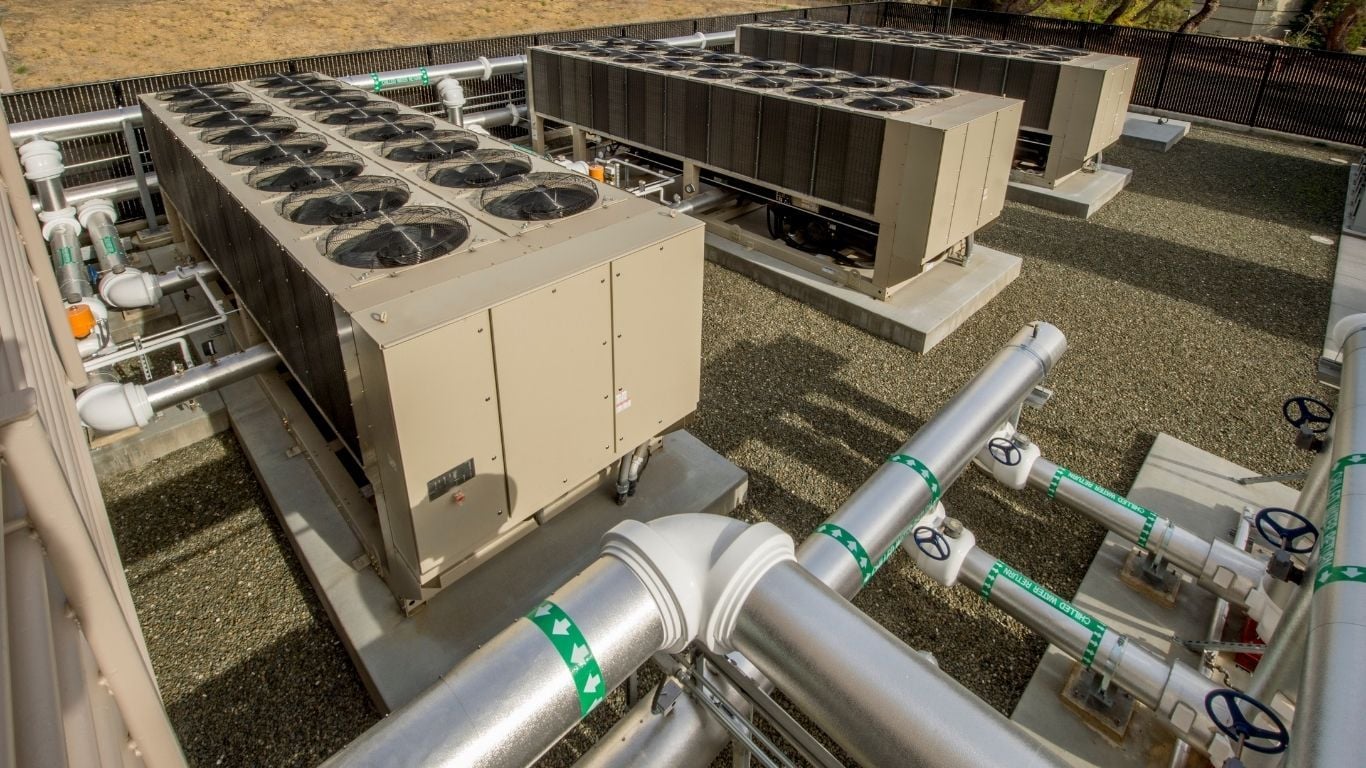
An air-cooled chiller rejects heat directly to outdoor air using condenser coils and fans. These systems are commonly installed on rooftops or exterior equipment pads.
Potential advantages include:
- No cooling tower
- No condenser-water loop
- Reduced water consumption
- Fewer water-treatment requirements
- A comparatively straightforward installation
Potential considerations include:
- Outdoor equipment exposure
- Fan noise
- Roof or equipment-pad requirements
- Performance changes during high outdoor temperatures
- Potentially higher energy use than an optimized water-cooled plant in some large applications
Air-cooled chillers can be a practical solution for many commercial buildings, but equipment should be selected using an engineered load analysis rather than building size alone.
Water-Cooled Chillers
A water-cooled chiller transfers heat to a separate condenser-water loop. That water normally carries the heat to a cooling tower, where it is rejected outdoors.
Water-cooled plants can deliver strong efficiency in larger or high-load applications, particularly when chillers, pumps and cooling towers are selected and controlled as a complete system.
However, their additional components introduce other responsibilities, including:
- Cooling tower maintenance
- Water treatment
- Condenser tube cleaning
- Pump maintenance
- Freeze protection
- Water-use management
- Legionella risk-management procedures
- More complex plant controls
Water-cooled systems should therefore be evaluated on total plant performance, not only the rated efficiency of the chiller.
Learn more about Ambient Mechanical's commercial chiller systems and support capabilities.
Boiler and Chiller Systems at a Glance
Commercial Boiler Systems
Primary function: Add heat to water or produce steam.
Common energy sources: Natural gas, electricity or another approved fuel source.
Typical applications: Space heating, perimeter heating, air handling unit heating coils and domestic hot water generation through a heat exchanger.
Important performance factors: Entering-water temperature, firing rate, combustion performance, staging, turndown and distribution-system design.
Common maintenance priorities: Combustion testing, heat exchanger inspection, safety-control testing, water treatment, scale prevention and venting-system inspection.
Commercial Chiller Systems
Primary function: Remove heat from water or another heat-transfer fluid.
Primary energy input: Electricity for compressors, pumps, fans and related components in most vapour-compression systems.
Typical applications: Comfort cooling, dehumidification and industrial process cooling.
Important performance factors: Entering and leaving water temperatures, compressor loading, condenser conditions, pump operation and part-load efficiency.
Common maintenance priorities: Refrigerant management, tube or coil cleaning, electrical testing, water treatment, oil analysis where applicable and operating-trend review.
Do You Need a Boiler, a Chiller or Both?
The correct central plant configuration depends on the building's heating and cooling loads.
Boiler Only
A boiler-only plant may be appropriate when a facility requires hydronic heating but uses a separate cooling system, such as rooftop equipment, variable refrigerant flow or packaged air conditioning.
This arrangement may be found in smaller commercial buildings, warehouses or properties where centralized chilled water is not economically justified.
Chiller Only
A chiller-only configuration may be suitable for facilities with substantial year-round cooling requirements and little or no conventional heating demand. Examples can include certain industrial processes, data-intensive facilities or buildings located within a district heating network.
Even in these applications, perimeter heating, ventilation-air heating or freeze protection may still require a separate heat source.
Boiler and Chiller Plant
Many office towers, hospitals, educational facilities and multi-unit residential buildings use both boilers and chillers.
The boilers serve heating loads during cold weather, while the chillers provide cooling and dehumidification during warmer conditions. Depending on the building, both systems may operate during shoulder seasons or even simultaneously in different zones.
Heat Pump or Hybrid Plant
Modern central plants may also incorporate air-source heat pumps, water-source heat pumps or heat-recovery chillers.
A heat-recovery chiller can collect heat removed from one part of the building and use it to satisfy a heating load elsewhere. A hybrid design may use heat pumps during favourable operating conditions while retaining boilers for peak heating, backup capacity or high-temperature loads.
These configurations can reduce energy use and emissions, but their feasibility depends on electrical capacity, available heat sources, distribution temperatures, operating schedules and project economics.
Ambient Mechanical's energy and sustainability consulting can help building owners assess efficiency, electrification and central plant modernization opportunities.
Five Factors That Should Guide Central Plant Selection
1. Building Load Profile
Equipment selection should begin with an engineering analysis of the building's actual heating and cooling requirements.
Important inputs include:
- Peak heating and cooling loads
- Hourly and seasonal load variation
- Simultaneous heating and cooling demands
- Occupancy schedules
- Ventilation requirements
- Process loads
- Humidity-control needs
- Planned building expansions
- Envelope and lighting improvements
Rules based only on square footage cannot account for these variables. Two buildings of the same size may require very different systems.
2. Existing Distribution Temperatures
The temperature required by the building's coils, radiators and terminal equipment can determine which plant technologies are practical.
For example, an older hydronic system designed around high-temperature hot water may not allow a condensing boiler or heat pump to achieve its best performance without additional distribution-system improvements.
Similarly, raising chilled-water temperatures may improve chiller efficiency, but the building's coils and humidity-control requirements must still be satisfied.
3. Electrical, Gas and Water Infrastructure
A central plant must be compatible with the utilities available to the facility.
An electrification project may require an electrical capacity study, transformer review, switchgear upgrades or new distribution equipment. A gas boiler plant requires appropriate fuel capacity, combustion air and venting. A water-cooled chiller also introduces cooling tower makeup-water and treatment requirements.
Evaluating these services early helps prevent expensive design changes after equipment has been selected.
4. Capital Cost and Lifecycle Cost
The lowest initial equipment price does not necessarily produce the lowest total cost of ownership.
A lifecycle analysis should consider:
- Equipment and installation costs
- Electrical or gas infrastructure upgrades
- Pumps, towers, heat exchangers and accessories
- Annual energy consumption
- Water and water-treatment costs
- Preventative maintenance
- Repair history and parts availability
- Expected operating hours
- Redundancy requirements
- Available incentives
- Anticipated equipment replacement timing
Ontario businesses may be able to access support for qualifying energy-efficiency projects through the Save on Energy Retrofit program. Eligibility and application requirements should be reviewed before equipment is ordered or project commitments are made.
5. Reliability and Redundancy
A facility that cannot tolerate a heating or cooling interruption may require multiple boilers, multiple chillers or another form of backup capacity.
Modular equipment can allow part of the plant to remain available while another unit is serviced. However, redundancy must be considered across the entire system, including pumps, electrical feeds, controls, cooling towers and heat exchangers.
An experienced HVAC retrofit and design team can evaluate these interconnected requirements before the project scope is finalized.
Why Building Automation Matters
A boiler or chiller may have an excellent published efficiency rating and still operate inefficiently if it is not controlled correctly.
A modern building automation system can coordinate:
- Boiler and chiller staging
- Hot-water and chilled-water temperature resets
- Pump speed
- Cooling tower fan operation
- Equipment lead and lag rotation
- Seasonal changeover
- Occupancy schedules
- Alarm reporting
- Operating trend collection
- Heat-recovery priorities
Open-protocol controls can also make future integration and expansion easier. However, interoperability should be confirmed through equipment specifications, controller capabilities and the contractor's programming scope.
Ambient Mechanical provides building automation and HVAC controls designed to improve equipment visibility and central plant coordination.
A Practical Central Plant Maintenance Plan
Preventative maintenance should follow equipment manufacturer instructions, applicable regulations and the facility's operating conditions. The following four-phase plan provides a useful starting point.
Phase 1: Prepare the Cooling Plant
Before the cooling season:
- Inspect the chiller and associated electrical components.
- Clean condenser coils or tubes as required.
- Check pumps, strainers and valves.
- Review refrigerant conditions and leak records.
- Test safeties, sensors and control sequences.
- Inspect the cooling tower and water-treatment system where applicable.
- Confirm that trend logs and alarms are working.
Phase 2: Monitor Summer Operation
During the cooling season:
- Track chilled-water supply and return temperatures.
- Review compressor loading and energy consumption.
- Monitor condenser conditions.
- Check cooling tower approach and water quality where applicable.
- Investigate unexpected cycling, alarms or changes in performance.
- Compare current operation with historical BAS trends.
Phase 3: Prepare the Heating Plant
Before the heating season:
- Inspect boilers, burners, venting and combustion-air systems.
- Perform combustion testing where applicable.
- Test operating and safety controls.
- Inspect pumps, valves and expansion equipment.
- Check water conditions and signs of scale or corrosion.
- Verify boiler staging and temperature-reset sequences.
- Confirm that freeze-protection strategies are operational.
Ontario owners and operators should also understand the requirements applying to regulated equipment through the Technical Standards and Safety Authority's boiler and pressure vessel guidance.
Phase 4: Maintain the Hydronic Systems Year-Round
Throughout the year:
- Monitor closed-loop water chemistry.
- Check system pressure and expansion-tank operation.
- Inspect for leaks and corrosion.
- Confirm that air separators and vents are functioning.
- Exercise valves and verify actuator operation.
- Review energy data for unexplained changes.
- Update maintenance records after every inspection or repair.
A structured commercial HVAC maintenance program can help facilities identify developing problems before they cause downtime or unnecessary energy consumption.
Questions to Ask Before Approving a Central Plant Project
Before choosing new boiler or chiller equipment, ask your engineering and mechanical partners:
- Has a current building load analysis been completed?
- How often does the facility operate at part load?
- Are heating and cooling required at the same time?
- Can heat recovery serve any existing loads?
- Are the current water temperatures appropriate for high-efficiency equipment?
- Does the building have adequate electrical, gas and water capacity?
- What supporting equipment must also be replaced?
- How will the BAS control and stage the new plant?
- What redundancy is required?
- What are the projected lifecycle costs?
- Are energy incentives available?
- How will the equipment be brought into and removed from the mechanical room?
- What commissioning and operator training are included?
These questions help move the conversation beyond equipment pricing and toward whole-system performance.
Build the Right Central Plant for Your Facility
Boilers and chillers perform different but complementary roles. Boilers add heat, while chillers remove it. For many facilities, the right solution is not choosing one over the other but determining how boilers, chillers, heat pumps, pumps, heat exchangers and controls should work together.
The best central plant design reflects the building's measured loads, available infrastructure, operational priorities and long-term financial goals. It should also provide maintainable equipment access, appropriate redundancy and controls that allow operators to understand how the plant is performing.
If you are planning a new central plant, replacing aging equipment or evaluating a boiler and chiller retrofit, contact Ambient Mechanical. Our team can help assess your facility, compare practical system configurations and develop a coordinated solution for reliable, efficient operation.
| Tags:Chiller SystemsBoiler Services |
